Multi-agent systems: what they are and how they work in 2026
A practical breakdown of the agents, protocols, and coordination patterns that let AI systems divide complex work like a specialized team.
A single large language model can only hold so much context, so many tools, and so many competing instructions before its output starts to slip.
Multi-agent systems solve that ceiling by splitting the work across a team of smaller, specialized agents instead of asking one model to do everything.
Each agent in the system handles one piece of the problem, such as retrieving data, drafting a response, or checking another agent's output for errors. An orchestrator coordinates the handoffs between them, the same way a manager assigns work across a team of specialists.
This article breaks down what a multi-agent system is, the components and architectures that make one work, and the benefits and challenges IT and operations teams run into when they build one.
It also covers where these systems show up in production today and when a simpler setup is the better call.
Key Takeaways
- A multi-agent system splits complex work across multiple specialized AI agents instead of relying on one generalist model.
- Agents coordinate through a shared environment, structured communication protocols, and an orchestration layer.
- Common architectures include hierarchical, sequential, parallel, network, and creator-verifier patterns.
- The main benefits are specialization and parallel execution; the main challenges are coordination overhead and error cascades.
- Not every task needs a multi-agent system. The simplest setup that reliably solves the problem is usually the right one.
What are multi-agent systems?
A multi-agent system is made up of multiple autonomous AI agents, each built on a large language model and assigned a specific role, working together in a shared environment toward one goal. Instead of one model trying to research, write, and check its own work, separate agents handle each of those jobs and pass their output to the next agent in line.
The AI agent, or agents, that assign tasks and manage handoffs are usually called the orchestrator, sometimes the supervisor.
Think of the orchestrator as the project manager of the system: it decides who does what and in what order, then reviews the combined result before it reaches the user.
This setup sits at one end of a wider spectrum of AI system design. At the other end is a structured agentic workflow, which follows a fixed script of steps a human has already defined; in the middle sits a single autonomous agent, which makes its own decisions but still works alone.
The table below compares all three setups side by side.
What are the core components of a multi-agent system?
Every multi-agent system, regardless of industry or framework, is built from four parts:
- The agents themselves
- The environment they share
- The protocols they communicate through
- The layer that orchestrates them.
Agents and roles
Each agent in the system is scoped to one domain, such as research, drafting, or verification, with its own tools and its own context window.
A context window is the amount of information a model can reference at once, and keeping it narrow and role-specific is what lets each agent stay accurate instead of getting overloaded.
Shared environment
The shared environment is the common workspace agents read from and write to, such as a shared task queue, a shared document, or a shared memory store.
It is what lets one agent's output become another agent's input without a human copying data between them.
Communication protocols
Communication protocols are the structured formats agents use to hand off state, rather than free-form chat that a human would need to interpret.
Two protocols have become the closest thing to a shared standard in 2026:
- The Model Context Protocol (MCP), which standardizes how an agent connects to external tools and data.
- Google's Agent2Agent protocol (A2A), which standardizes how agents discover and message each other.
Make's guide to AI agent orchestration goes deeper into how these handoffs are coordinated in a live production setup.
Orchestration layer
The orchestration layer is the control logic that assigns subtasks, sequences the work, and resolves conflicts when two agents produce different outputs.
It can be centralized, with one supervisor agent making every call, or decentralized, with agents negotiating directly among themselves.
How do multi-agent systems work?
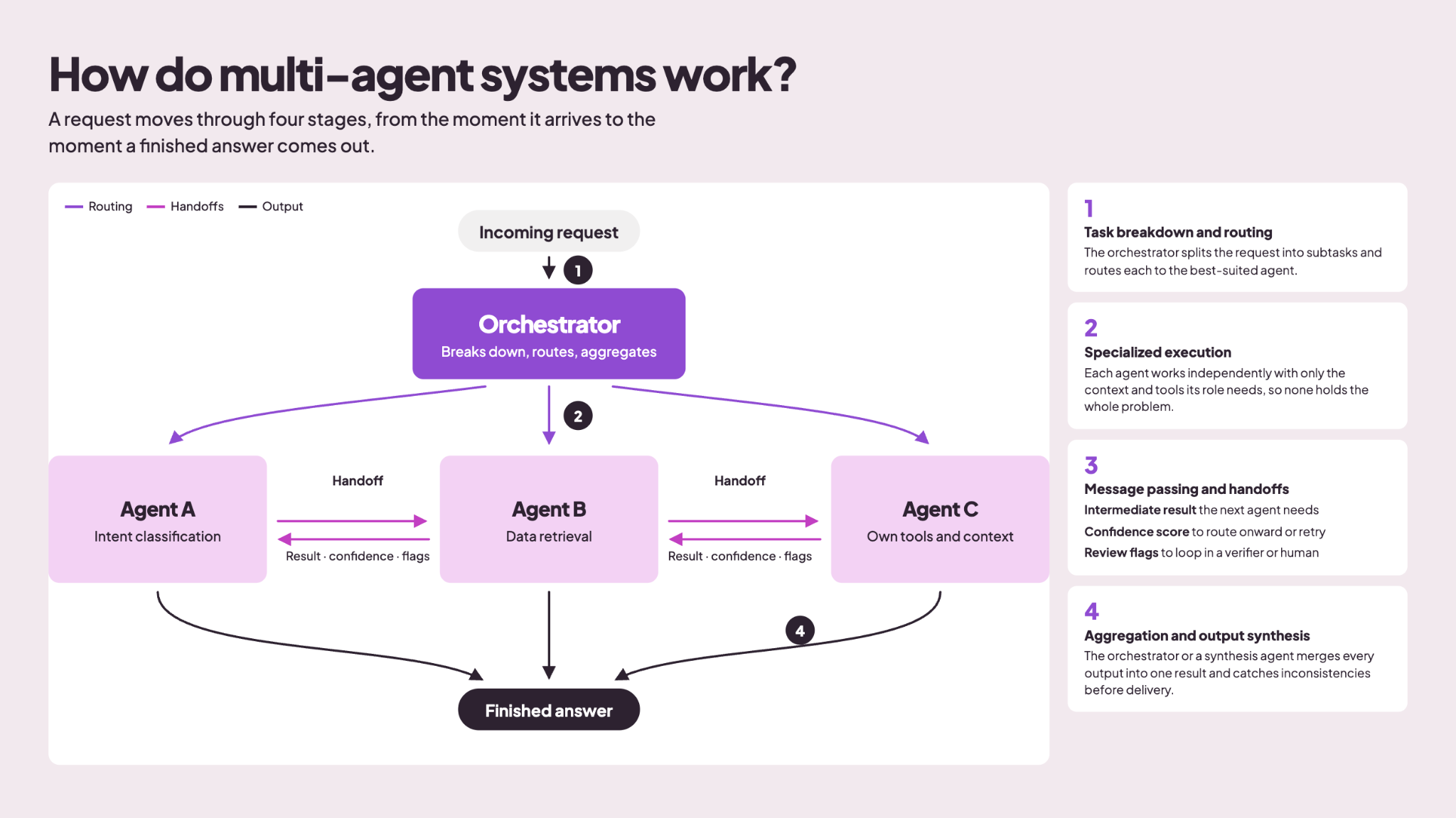
A request moves through a multi-agent system in four stages, from the moment it arrives to the moment a finished answer comes out the other side.
Step 1: Task breakdown and routing
The orchestrator receives the incoming request and breaks it into subtasks, then routes each subtask to the agent best suited to handle it.
A customer support request, for example, might split into an intent-classification subtask and a data-retrieval subtask, sent to two different agents.
Step 2: Specialized execution
Each agent works its subtask independently, drawing only on the context and tools relevant to its role.
This is where the context-efficiency benefit shows up, since no single agent has to hold the entire problem in its context window at once.
Step 3: Message passing and handoffs
Handoffs between agents typically carry three things: the intermediate result itself, a confidence score, and any flags for human review.
- The intermediate result: the actual output the next agent needs to keep working on, such as a retrieved record or a draft paragraph.
- A confidence score: a signal for how sure the sending agent is about its output, which helps the orchestrator decide whether to route the output onward or send it back for another pass.
- Review flags: markers an agent attaches when it hits something outside its scope, prompting the orchestrator to loop in a verifier agent or a human.
Step 4: Aggregation and output synthesis
The orchestrator, or a dedicated synthesis agent, merges the outputs from every agent involved into one coherent result.
That final pass is also where inconsistencies between agents get caught, before the answer reaches the user or the downstream system.
What are the common multi-agent architectures?
Most production agent systems in 2026 are built from five recurring architecture patterns, each suited to a different kind of coordination problem.
Hierarchical (supervisor) architecture
One orchestrator, or supervisor agent, delegates subtasks to worker agents and reviews their output before passing it along.
This is the most common pattern in enterprise deployments because it keeps a single point of accountability for the final result.
Make's explanation of an agentic operating system covers this supervisor pattern in more detail.
Sequential (pipeline) architecture
Agents run in a fixed order, and each one's output becomes the next one's input, similar to a factory assembly line. It suits problems where the steps themselves do not change, even if the content passing through them does.
Parallel (concurrent) architecture
Multiple agents work on the same problem simultaneously from different angles, and their results get merged afterward.
This pattern trades some coordination simplicity for speed, since agents are not waiting on each other.
Network (decentralized) architecture
Agents negotiate directly with each other with no single controlling supervisor, closer to a peer group than a chain of command.
It scales well but is harder to debug, since no one agent has the full picture of what happened.
Creator-verifier (adversarial) architecture
One agent generates output, such as code or a written plan, and a separate agent independently checks or challenges it before it ships.
This pattern catches mistakes a single agent would have no way to catch in its own work.
The table below summarizes how the five patterns differ in coordination style and best fit.
What are the benefits of multi-agent systems for automation teams?
Splitting work across specialized agents brings five advantages that a single, generalist model cannot easily match.
- Role specialization: each agent is tuned for one job, such as classification or verification, instead of compromising across many jobs at once.
- Parallel execution: independent subtasks can run at the same time instead of moving through one long sequential chain.
- Context efficiency: each agent holds only the context for its own subtask, not the whole problem, which keeps its prompt smaller and more accurate than one agent tracking everything at once. That's a quality gain, not a cost saving: running several agents together typically costs more in total tokens than one agent would, which is the tradeoff covered in the challenges section below.
- Shared accountability: a verifier agent can catch another agent's mistake before it reaches production, the same way a second reviewer catches what a first reviewer missed.
- Scalability: teams can add a new specialized agent for a new subtask without rebuilding the whole system. Make's guide to workflow orchestration covers how this kind of modular scaling works in a production automation setup.
What are the challenges of multi-agent systems?
The same coordination that makes these systems powerful is also where most of their problems come from.
- Coordination overhead: more agents means more handoffs, and each handoff is a place where information can get lost or garbled.
- Error cascades: a small mistake at one handoff can compound as it passes through the rest of the chain, unlike a single agent's isolated error.
- Higher token and compute cost: running several agents, even smaller ones, typically costs more than running one larger model on the same task, since each agent carries its own system prompt and the handoffs between them add extra tokens for orchestration and review that a single model wouldn’t need.
- Debugging complexity: tracing a failure back through multiple agents and handoffs takes longer than debugging one model call.
- Governance and observability gaps: without strong logging across every agent, a multi-agent system can become a black box where teams can’t see why it drifted from the intended goal. Make avoids this by running every agent as a visible step in the “Scenario Builder,” with a full execution history of inputs and outputs for each run, so you can trace exactly where something went wrong instead of guessing. Make’s guide to agentic process automation covers the structured logging and rules-based guardrails behind that visibility.
When should you use a multi-agent system?
Two questions decide whether a multi-agent system is worth the added complexity. The first is what practitioners call the workflow test: can this problem be solved by a fixed sequence of steps a human has already defined?
If the answer is yes, a structured workflow, a fixed, deterministic sequence of steps that runs the same way every time, is faster, cheaper, and easier to maintain than a multi-agent system. Make's explainer on agentic AI lays out where a single agent or a structured workflow is the better starting point.
The second question is the skill gap test: does the problem require genuinely different expertise across its subtasks, such as legal review versus financial modeling?
A multi-agent system earns its added complexity only when both are true: there’s no fixed sequence of steps that reliably solves the problem, and its subtasks genuinely require different kinds of expertise, not when the architecture simply looks impressive.
The table below maps common signals indicating which setup fits your use case the best.
What are real-world use cases for multi-agent systems?
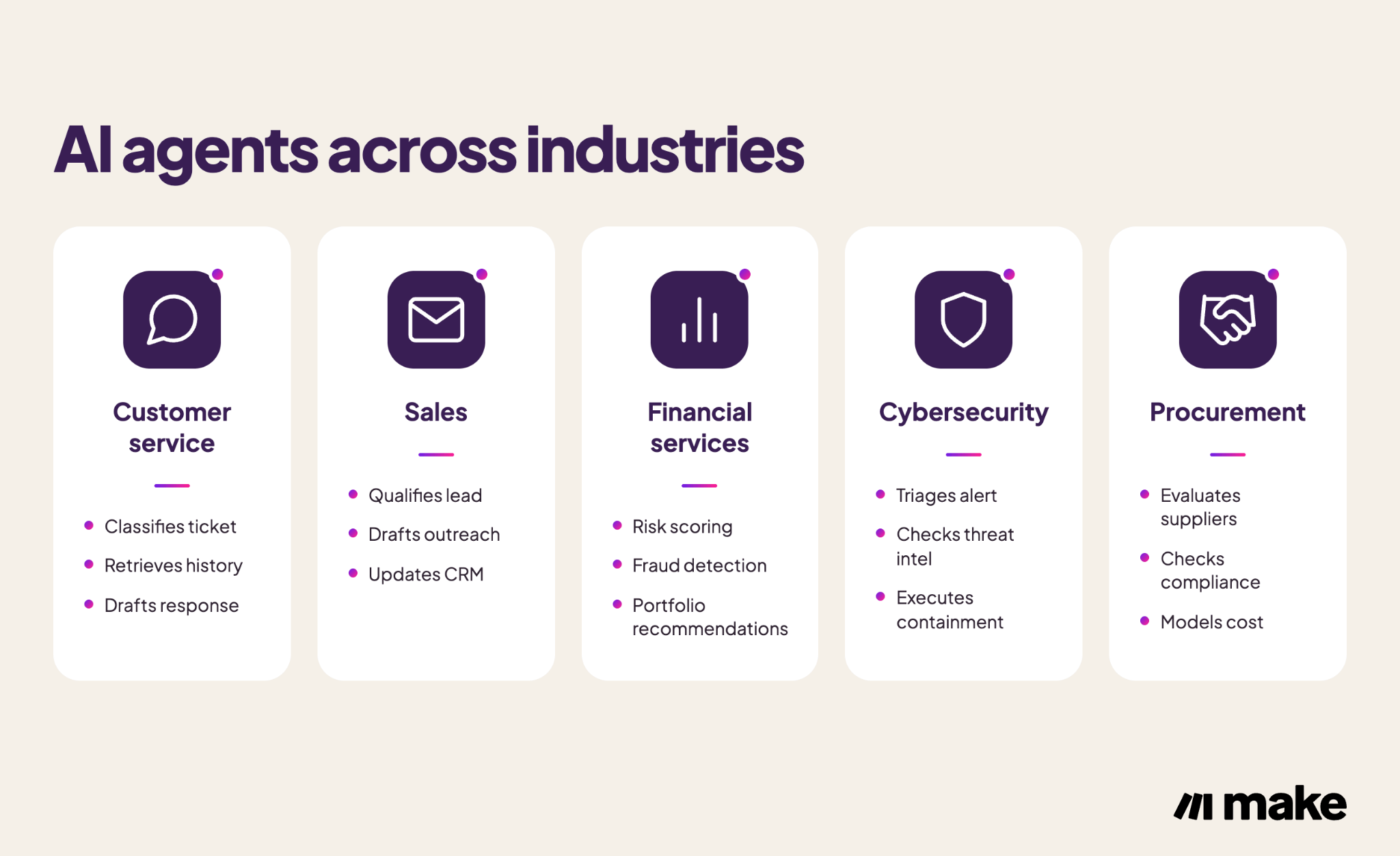
Companies across five industries are already running multi-agent systems in production, each assigning a different specialist role to a different agent.
These are examples, not a complete list of every industry using them.
Customer service and support operations
One agent classifies the incoming ticket by intent, a second retrieves the customer's account or order history, and a third drafts the response before a human reviews or sends it.
Make's customer experience automation solutions apply this same pattern to route and resolve support tickets automatically.
Sales and revenue operations
A qualification agent checks inbound leads against a company's ideal customer profile, an outreach agent drafts a personalized first message, and a follow-up agent updates the CRM and books meetings.
Make's sales automation solutions coordinate this kind of multi-step outreach across connected apps.
Financial services and risk management
Separate agents handle risk scoring, fraud-pattern detection, and portfolio recommendations, sharing signals so a single flagged transaction gets consistent treatment across all three.
No one agent sees the full financial picture alone; the coordination across them is what produces a reliable decision.
Cybersecurity and incident response
A triage agent classifies and prioritizes incoming alerts, a threat-intelligence agent cross-references them against known indicators of compromise, and a response agent executes or recommends containment actions.
Splitting the work this way lets a security team handle far more alerts in parallel than one analyst, or one general-purpose model, reviewing every alert in sequence.
Procurement and supply chain
A sourcing agent evaluates suppliers, a compliance agent checks contracts against regulatory requirements, and a negotiation agent models cost scenarios, all feeding into one recommendation.
This mirrors how a procurement team already splits the same work across specialists today.
What platforms and frameworks power multi-agent systems?
Four platforms account for most multi-agent deployments in 2026, ranging from open-source code frameworks to a fully visual, no-code option.
LangGraph
LangGraph models agent workflows as a directed graph with typed state and built-in checkpointing, which lets a team pause, inspect, and resume a run midway through.
It has the largest production footprint of the open-source frameworks, particularly for teams that need strict control
CrewAI
CrewAI organizes agents into role-based crews rather than starting from a graph, which makes it one of the fastest frameworks for going from an idea to a working prototype.
Recent versions added support for the MCP and A2A protocols, letting CrewAI agents interoperate with agents built on other frameworks.
AutoGen (AG2)
AutoGen, now maintained as AG2, coordinates agents through a group chat model where a selector decides which agent speaks next.
It suits conversational, debate-style multi-agent setups better than pipeline-style ones.
No-code orchestration with Make
Make pairs a visual Scenario Builder with an AI Agent module and a Router, so IT and operations teams can assemble agent coordination without writing the orchestration layer from scratch. Each agent still gets its own role, tools, and context; the difference is that the coordination logic is built visually instead of in code.
The Make AI Agents product page details how these pieces fit together, and the guide to building AI agents with Make walks through a first working setup.
What will your first agent team work on?
The decision test from earlier in this piece is the one worth returning to before building anything: match the setup to how genuinely complex and multi-skilled the problem actually is, not to which framework or architecture happens to be popular right now.
A good starting point is mapping one existing workflow's subtasks and checking whether any of them would benefit from a dedicated specialist agent rather than one generalist trying to cover all of them.
Make's post on introducing Make AI Agents is a practical next stop for teams ready to test that first specialist agent inside an existing scenario.
Frequently asked questions
1. What is the difference between a single AI agent and a multi-agent system?
A single AI agent works alone, using its own tools and context to complete a task from start to finish. A multi-agent system splits that same task across several agents, each handling one part and coordinating through an orchestrator.
2. What is the difference between an agentic workflow and a multi-agent system?
An agentic workflow follows a fixed sequence of steps that a human defines in advance, such as classify the ticket, then retrieve the order history, then draft a reply. Individual steps inside it can still call an AI model and produce different output each time, what’s fixed is the order of steps, not what each one generates. A multi-agent system makes dynamic decisions about which agent handles what and in what order, adjusting as the task unfolds.
3. How do agents communicate with each other in a multi-agent system?
Agents pass structured messages rather than free-form text, typically including an intermediate result, a confidence score, and any flags for review. Protocols such as MCP and A2A standardize the format of these messages so agents built on different frameworks can still work together.
4. Do you need a multi-agent system for every AI automation project?
No. Most well-defined, repetitive tasks are better served by a structured workflow or a single autonomous agent, both of which are simpler to build and cheaper to run.
A multi-agent system earns its added complexity only when a task genuinely requires coordination across different specialties.
5. What causes multi-agent systems to fail in production?
The most common cause is an error cascade, where a small mistake at one handoff compounds as it passes through the rest of the chain. Weak observability makes this worse, since teams cannot see where in the chain the drift started.
6. Which industries are using multi-agent systems today?
These systems are already running in customer service, sales operations, financial services, cybersecurity, and procurement. In each case, the pattern is the same: separate agents handle separate specialties and share their results through a coordinating layer.
Related blogs
Tool and strategies modern teams need to help their companies grow.
AI
AI agents vs ChatGPT: what's the difference in 2026?
Most teams use ChatGPT. Few use AI agents. Here is the difference and how to start automating with Make.

Raife Dowley
May 19, 2026
AI
Agent workflow memory: 2026 guide to AI agents that remember
Discover how agent workflow memory enables AI agents to retain context across sessions. Learn architecture patterns and implementation strategies for 2026.
Raife Dowley
May 5, 2026
Information Technology
AI agent orchestration – a critical business imperative
As more and more businesses implement AI-powered automation, having visibility and control over your AI landscape is more important than ever. This article outlines how AI agent orchestration is becoming a vital ingredient for successful businesses.